per ESPN's Mike Reiss. "I really do believe Cam getting COVID, and what it did to the team, it changed a lot. Now we'll get a chance to see.
"Players on the team, in the locker room, really love the guy. In the end, I trust Coach Belichick's ability to build a team, and put the right players in the best position to succeed."
Newton re-signed with New England on a one-year deal this month after starting 15 games for the team last season. He completed 65.8% of his passes for 2,657 yards, eight touchdowns and 10 interceptions. He also rushed for 592 yards and 12 scores.
Kraft also addressed his uncharacteristic shopping spree in free agency this offseason, during which he spent a league-record $165 million in guaranteed money. Kraft said his preference is to build a team through the draft, but cited his team's poor performance in recent drafts—as well as the NFL's reduced salary caps handcuffing other teams—as factors that led to his unprecedented spending.
"What happened here last year was not something to our liking. We had to make the corrections," Kraft said. "In all the businesses we're involved in, we try to take advantage of inefficiencies in the market. We were in a unique cap situation this year and it allowed us to try to [fix] things we missed, to a certain extent, in the draft. So this was our best opportunity."
The Patriots will pick 15th in the upcoming draft, their highest pick since 2008. That year, the team took linebacker Jerod Mayo with the 10th pick.
Kraft also said he did not regret letting Tom Brady leave via free agency, rather than retaining him using the franchise tag. Brady went on to lead the Buccaneers to a Super Bowl title, winning the title game's MVP honors in the process.
"After 20 years, I'll make this commitment to any player in the future. Anyone who spends 20 years with us, and helps us go to win six Super Bowls, we're not going to keep; look, we could have contract-wise, kept him in our camp," Kraft said. "But it's not the right thing."
The near month-long event has provided a much-needed cash infusion to the local hospitality industry that's been rocked by the pandemic. The Marriott was closed for nine months starting last March and only reopened for weekends in January before wrapping itself in an invisible bubble with a surge of clients starting with the Big Ten tournament.
It will, finally, reopen to the public on April 13, Moros says. By that time, his hotel would have hosted two dozen basketball teams, more than 500 basketball and football players, another 300 college coaches and staff members, nearly 100 NFL personnel and blocked off more than 1,200 rooms over 33 days—all the while operating with 300 fewer hotel employees than normal.
It's another sign that the country is emerging from the COVID cave, and Moros couldn’t be more ecstatic.
“We’re seeing light at the end of the tunnel,” he says.
Snyder reportedly bought the remaining 40.5% of the team from minority investors Fred Smith, Dwight Schar and Robert Rothman. The $875 million sale and $450 million waiver were both approved by the NFL.
Snyder needs to repay the debt by 2028, according to ESPN.
In November The Washington Post reported that a group of investors offered minority owners $900 million to sell their shares but Snyder blocked the move.
It's been a turbulent year for the The Washington Football Team and Snyder. The team is going through a rebrand after removing its previous name and this summer The Washington Post released an investigation that detailed numerous sexual harassment claims centered around team executives.
The NFL has since started to oversee a third-party investigation that was initially launched by the Football Team after the Post's revelations.
With this reported move, Snyder and his family gain complete control of the team that he bought from Jack Kent Cooke's estate in 1999. The franchise holds a 149-202-1 record since then.
avalanche of lawsuits and allegations against him seriously enough. For obvious reasons, I don’t want to do that.
But I’d say we’re at the point where a suspension would seem to be on the table. The NFL has taken guys off the field in the past for actions that paint the league in a bad light, and just with what we already know, even if Watson is innocent of most of what more than 20 women have described (including a detailed report from our own Jenny Vrentas), it seems like we’ve hit that threshold. Ben Roethlisberger got a six-game suspension in 2010 after a woman gave her account of sexual assault, which was reduced to four games when he met certain conditions. And while the situations are very different, it wouldn’t surprise me if that’s the standard the NFL uses.
Still, what we’re talking about isn’t whether Watson will play again, it’s when he will. Things, of course, could get considerably worse for Watson legally. Or they could get better. We have to let that part play out. What I will say is that I believe now that the likelihood that Watson will play his next snap in a new uniform is increasing, and that the Texans will listen to offers, including some that may include capital contingent on Watson’s playing again.
From The Disc Golf Dad (@Ryandosparks): If the draft starts Trevor Lawrence, Zach Wilson, Mac Jones, do the Falcons jump on Justin Fields and then the Panthers panic and give Cincy pick No. 8 and 39 for the fifth pick? Feels possible and Cincy would still end up with either Chase, Pitts, Sewell.
Disc Golf Dad, I love your question, because I love playing out these scenarios. Here’s what we know about the Panthers: They want an upgrade over Teddy Bridgewater or, at the very least, competition for him. And that could come in a number of different forms. The one thing I would caution anyone from doing here, though, is assuming that the top five quarterbacks are all seen as worthy of a top-10 pick by every team. It doesn’t work that way.
So if the one that slips to five, in this scenario, is one the Panthers really love, then I absolutely could see new GM Scott Fitterer’s getting aggressive to try to outflank teams like Denver and New England to land Carolina’s guy. But the possibility also exists that the Panthers aren’t wild about the one that will shake free from the top four picks. And in that case, if they don’t wind up with Watson, it wouldn’t stun me to see a trade for Sam Darnold, with a plan to have Darnold compete with Bridgewater for the job.
(I still, for what it’s worth, think there’s something there with the 23-year-old Darnold. But where he lands next will be critical.)
As for the second part of how you drew this one up, the Bengals haven’t moved around in the first round a lot. In fact, since trading up for Ki-Jana Carter in 1995, it’s happened just three times. They moved down in 2004 (Chris Perry), ’12 (Kevin Zeitler) and ’18 (Billy Price). And in two of those three cases, they were acquiring a veteran as part of the deal (Deltha O’Neal in ’04 and Cordy Glenn in ’18).
That says to me that it might take a lot to wrest the fifth pick from the Bengals, who I’ve heard really like LSU’s Ja'Marr Chase (with Joe Burrow doing a little in-house campaigning for him as well), and would also have the option to seriously upgrade the offensive line there with Oregon’s Penei Sewell or Northwestern’s Rashawn Slater. Miami at No. 6? Maybe, if the Dolphins don’t wind up moving that pick for a certain veteran quarterback.
From Logan Williams (@IndieWolverine): With chances for QB going 1 through 4, do you think it’s also possible for a Cincy trade back to make it QB 1 through 5?
Like I said, sure, there’s a chance. But very clearly, a team is going to have to make it worth Mike Brown, Duke Tobin and Zac Taylor’s while to do it, and my guess is they probably wouldn’t want to drop too far back, with a focus on getting their rising sophomore quarterback some help as he returns from his ACL tear.
From Bill Adams (@BAdams3324): What do you think the Pats’ answer at QB is for the long-term?
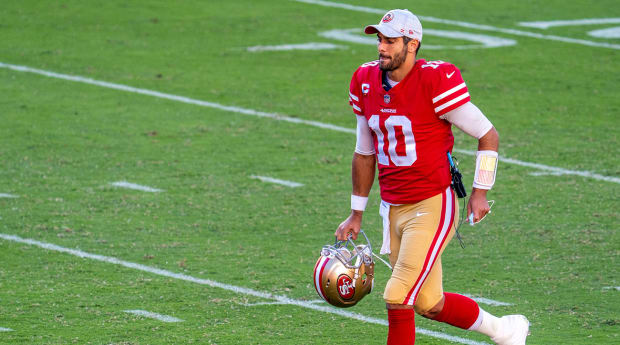
Bill, this is going to be an underwhelming answer: I don’t know. I think they’d love to have Garoppolo, but I’d be a little surprised if they were looking to hitch the next decade to him. One reason the Niners started to look at moving on from him in the first place was because he simply hasn’t been able to stay on the field.
In the three years since he signed his five-year, $137.5 million deal there, he’s missed almost as many starts (23) as he’s made (25). Throw in 2017, and the two games he missed out of four he was slated to start for the Patriots, plus the three games he sat before starting the last five of that year for the Niners, and you’re talking about a 60-game sample size over which Garoppolo’s been a team’s de facto No. 1. He started 31 of those games.
Generally, these sorts of issues don’t improve as a player moves into his 30s, and Garoppolo is turning 30 in November. And I like Garoppolo as a player. But I’m not sure he’s shown himself to be the level of player, like, say, Cam Newton was last offseason as a former MVP, where a team would be willing to roll the dice on his ability to stay healthy without covering itself with some major league insurance.
All of that is to say whether it’s Newton or Garoppolo or both on the roster in July and August, I’d think there’ll be a rookie there to compete, along with incumbent young guy Jarrett Stidham. And with the likelihood seeming to be slipping that any of the top five quarterbacks will make it to 15, I think Day 2 prospects like Texas A&M’s Kellen Mond, Florida’s Kyle Trask and Wake Forest’s Jamie Newman could be in play.
Let me put this one on your radar, too: Keep an eye on Stanford’s Davis Mills for the Patriots. He hasn’t played a ton (he wrested the Cardinal’s job from K.J. Costello in only 2019), but he’s a former five-star high school prospect who has every tool you’re looking for, and the Patriots have never been afraid to take swings on quarterbacks with different college careers. Garoppolo’s an example of that, as are guys like Stidham, Matt Cassel and Jacoby Brissett. It wouldn’t surprise me if they see similar distressed-asset value here.
From Raghav S (@RaguSaini92): What are your thoughts on rookie QB3 versus Matthew Stafford? 49ers favor the rookie apparently.
Raghav, that’s an interesting question because it pits the Niners and Rams against each other in the NFC West in an it’ll-be-fun-to-look-at-the-scoreboard-after-this kind of way. My understanding at the time of the Stafford trade was that he had three preferred destinations: Los Angeles, San Francisco and Indianapolis, in that order. The Colts never offered their first-round pick, No. 21, for Stafford. And the Niners never got to the point where they made an offer for him.
Why? Well, they’d talked to Detroit about a Stafford trade at the Senior Bowl in Mobile, Ala., with plans to circle back with the Lions after the weekend to follow. But things accelerated that Friday, and by Saturday a deal was in place that made Stafford a Ram. Before doing the deal, Detroit did check in with the Niners. But at that point, the Rams, Panthers and Washington all had made offers well beyond where San Francisco was willing to go.
My sense at the time was the Niners weren’t going to put the 12th pick on the table in the first place to get Stafford, and my guess is part of that related to Stafford’s issues staying healthy. San Francisco’s own experience with Garoppolo might have made it leery about paying big for a quarterback with a lot of injury history.
Meanwhile, the Rams went all in, handing over two future first-round picks and their third-rounder this year to land Stafford. So from here, we’ll get to see who was right and who was wrong, and another story line linking two rivals that already have a lot of ties to one another.
From Rob (@rpciii): Can you dive into what role Dave Ziegler will have in the draft prep and the draft and if he will have a say I’m the picks?
Hey Rob, Dave Ziegler is basically now in the position that Nick Caserio was in for the last 12 years. It won’t be exactly the same, of course, because Caserio got more responsibility as he went along in New England. Just as Caserio had Bill Belichick’s old friend Floyd Reese helping to smooth the transition as Scott Pioli left for Kansas City, Ziegler has a guy, in Matt Patricia, with a lot of program-specific institutional knowledge working with him.
But the good news is that the transition is already underway, to a degree. Last year, Ziegler took on a new title (assistant director of player personnel) and added responsibility working under Caserio. Where before, as the team’s pro scouting director, Ziegler was focused on that side, he started to do more on the college side and got some experience with other facets of New England’s scouting operation.
For those reasons, the Patriots felt pretty good putting him behind the wheel when Caserio landed the Houston job. And with Ziegler’s showing up in places like LSU’s pro day on Wednesday, I’d expect he’ll have the seat in the Patriots’ very small draft room that Caserio and Pioli once occupied—right next to Belichick.
From Gary (@GaryFromTheBay): Who are the 49ers picking at No. 3?
Gary, I’ve heard, like everyone else, from teams convinced that San Francisco is taking Alabama’s Mac Jones. One coach pointed out to me, in comparing Jones to Ohio State’s Justin Fields and North Dakota State’s Trey Lance, “He’s more accurate than the other two in all ways. If you look at the QBs Kyle has played with over the years, they are a lot more like Jones than the other two.” And that much you can see, in looking at Jones’s strengths against those of guys like Matt Schaub, Kirk Cousins and Matt Ryan.
That said, this coach conceded that it comes down to looking at the floor versus the ceiling on each of the three, with Jones’s edge now in the evidence that he throws accurately and on time, and exhibits consistent, efficient pocket movement.
And the ceiling-vs.-floor argument is why the idea of Jones is, at the very least, a little eyebrow-raising. I know what people have said about other teams in the top 10 picks. But knowing what I know at this point, I think there’s a decent chance Jones would’ve been there for the Niners at 12. Also, there’s the question of the price (three first-round picks and a third-round comp pick) versus the level of upgrade Jones would be.
All of this isn’t to take away from Jones, by the way, because he’s a really good player. There’s no question Fields and Lance would need work. Fields needs to play less hero ball and get the ball out faster more consistently. Lance is raw in a lot of ways (though he is very much a fit stylistically for a Shanahan offense). But here’s the thing about that: If the Niners do hold on to Garoppolo, they’d have the luxury the Chiefs did with Alex Smith and Patrick Mahomes in 2017, to give their quarterback a redshirt year to develop through.
And given that redshirt year, and the coaching Shanahan and his staff would bring to the table? You’d think the sky would be the limit with Fields or Lance. We’ll find out in a month if the Niners feel that way about Jones, too.
From Shedrick Carter (@shedrickcarter2): Draft looks set with 3 quarterbacks going 1-2-3. So the draftpretty much starts at 4. Do you see Atlanta going QB or best player available (Pitts)?
Shedrick, it seems likely to me that the Falcons will either take a quarterback or move the pick to a team that will. This year, because of the limitations on team people allowed per pro day (three), the lack of exposure to these prospects in the fall and no combine, and the inability of teams to bring players in for 30 visits or to go to their campuses to meet with them and work them out privately, I believe who teams choose to send to pro days is significant. And Atlanta’s actions in that regard are interesting.
Falcons GM Terry Fontenot and coach Arthur Smith have been on the ground at Clemson to see Lawrence, North Dakota State to see Lance, BYU to see Wilson, Alabama to see Jones and Ohio State to see Fields. They’re doing every bit the work that the Jets and Panthers are, and that the Niners will now that their trade is complete, in vetting the QB class.
Now, the question will be whether they will love the one who falls to them at No. 4. I don’t know the answer to that. But I do know they’ve done every bit of homework as if they plan to take one there, they’re aware (like everyone else is) that the 2022 picture is muddy at best at the position and they don’t plan to be picking in the top five much in the future. So if the one that drops in their lap is one they love, I don’t think Fontenot will hesitate to pull the trigger. And if they don’t love who’s there? I’d bet someone will make them an aggressive offer.
Lockett, 28, had previously signed a three-year, $31.8 million contract extension with Seattle through the 2021 season ahead of the 2018 season.
Lockett has played all of his NFL seasons with the Seahawks, catching 376 passes for 4,892 yards and 37 touchdowns for his career.
In 2020, Lockett led Seattle in receptions (100) and finished second on the team in receiving yards (1,054) and tied for second in touchdown receptions (10). He broke a single-season team record for pass receptions last season that was previously held by Doug Baldwin and Bobby Engram.
Lockett earned his first and only Pro Bowl honors as well as NFL First Team All-Pro honors in his rookie season in 2015. Since then, Lockett has earned second team All-Pro honors in 2016 and 2017.
In 2015, Lockett was the second rookie to win multiple special teams Player Of The Month awards and was the only rookie to be name First Team All-Pro for that season. He also was selected to the 2015 Pro Football Writers Association NFL All-Rookie Team at three positions.
Seattle drafted Lockett No. 69 in the third round of the 2015 NFL draft.
In that same time, a total of 40 wide receivers have been selected in Round 1. The trend of statistical success at the position hasn’t been all that great, though. So, let’s take a walk down memory lane and reminisce on all of the first-round wideouts since 2012, how they fared as rookies and how many of them actually become fantasy studs.
2020
Henry Ruggs III, Jerry Jeudy, CeeDee Lamb, Jalen Reagor, Justin Jefferson, Brandon Aiyuk
The 2020 rookie class was loaded with talented wideouts, so it's no surprise that a total of six went in the first round. Jefferson was the best of the bunch, recording a rookie record 1,400 yards while finishing with the fourth-most points among rookie wideouts all-time. Lamb finished as the WR22, but he could have been much better had his starting quarterback, Dak Prescott, not gone down with a season-ending injury. Aiyuk was the WR36, but he showed flashes of becoming a real star in the world of fantasy football.
The rest of the wideouts in the round, Jeudy, Reagor, and Ruggs III, finished WR45 or worse. Ruggs III, who was the first wideout drafted, finished last in the group at WR94.
2019
Marquise Brown, N’Keal Harry
Brown and Harry were the lone wideouts drafted in the first round in 2019, and neither has made a significant fantasy impact. Brown has finished no better than WR36 in his first two seasons, and he’ll have a tough time breaking out in a Ravens offense that runs the ball a ton and just added Sammy Watkins. Harry’s best finish is WR99, and that won’t improve with the Patriots adding Hunter Henry, Jonnu Smith, Nelson Agholor, and Kendrick Bourne in the offseason. At this point, Harry is a dynasty stash at best.
2018
D.J. Moore, Calvin Ridley
Moore and Ridley have both met expectations to this point in their young careers. The former has a pair of top-25 finishes on his resume, while Ridley has finished no worse than WR27 and broke out to become the WR5 a season ago. The Falcons wideout is now locked-in as a top-25 pick, and Moore should see an increase in his WR25 finish with the loss of Curtis Samuel to the Washington Football Team during free agency.
2017
Corey Davis, Mike Williams, John Ross
The 2017 first-round wide receivers have been a disappointment, to say the least. The fifth overall pick in the draft, Davis's best fantasy finish in his four seasons is WR28. He'll look to improve that as a member of the Jets. Williams has failed to finish better than WR41 in his four seasons, and Ross has been injury-prone at the NFL level. He's played in eight or fewer games three times and has left the Bengals for the Giants.
2016
Corey Coleman, Will Fuller, Josh Doctson, Laquon Treadwell
Browns fans might want to forget, but Coleman was the first wide receiver picked (No. 15 overall) in the 2016 draft. He never ranked better than WR84 and finished his career with 61 catches over three seasons. Doctson, the No. 22 overall pick for Washington, never finished better than WR57. Treadwell, the Vikings' first-round selection, never ranked higher than tied for 94th among fantasy wideouts. Fuller has had the most, well, “success” in the league out of the quartet. However, he’s never finished better than 32nd in points at the position. He was on pace for a potential top-10 finish in 2020, but a league-imposed suspension cost him his final five games and any chance at stardom.
2015
Amari Cooper, Kevin White, DeVante Parker, Nelson Agholor, Breshad Perriman, Phillip Dorsett
Much like in 2020, the 2015 NFL Draft had a combined six wideouts come off the board in the first round. The results, unfortunately, weren’t nearly as positive. Cooper was the WR21 as a rookie, and he's gone on to produce four other top-20 finishes, including one top-10. He's been the lone bright spot in this class, however. White was never able to avoid injuries and failed to rank higher than 123rd among wide receivers. Parker has finished better than WR40 just once (WR11 in 2019) in his career, while Agholor, Perriman, and Dorsett have zero top-20 finishes and just one top-25 finish among them.
2014
Sammy Watkins, Mike Evans, Odell Beckham Jr., Brandin Cooks, Kelvin Benjamin
As bad as the 2015 class was among first-round wideouts, the 2014 class is considered one of the best. Beckham Jr., Evans, and Benjamin all finished in the top 20 in points as rookies, including OBJ's WR7 rank. He's gone on to produce three top-seven finishes and another top-15 finish, though his stats have shrunk in Cleveland. Evans has been no worse than WR23 in his five NFL seasons, including a pair of top-nine ranks. Cooks wasn’t a star as a rookie, but he’s gone on to produce five top-15 seasons. Watkins showed promise earlier in his career, but he’s finished no better than WR41 in each of his last three seasons. Benjamin also looked good earlier in his career, but he missed the entire 2015 season with an injured knee and was out of the NFL after 2018.
Austin, the No. 8 overall pick of the St. Louis Rams, never had a top 25 finish among wideouts. His best rank came in 2015 when he was the WR27. Not exactly what the Rams or fantasy fans were expecting from the former West Virginia star. Patterson was seen as a potential fantasy sleeper after showing flashes of potential as a rookie, but he failed to meet expectations and ended up bouncing around the league after 2016.
The biggest winner of this trio, of course, is Hopkins. After finishing 50th in fantasy points as a rookie, Nuk has put up finishes of WR14, WR4, WR2, WR2, and WR5. He's been the best first-round wide receiver in the NFL draft in the last eight seasons.
2012
Justin Blackmon, Michael Floyd, Kendall Wright, A.J. Jenkins
Blackmon was considered a massive prospect coming out of Oklahoma State, but off-field issues became a major problem. He never finished better than WR29 and was out of the league after three years. Floyd showed some flashes with the Cardinals, but he had just one top-30 finish among wideouts. Wright has a top-20 finish on his resume, but he never met the expectations of a first-round wideout. The same can be said of Jenkins, who played three games for the Niners and was out of the league after 2014.
Breakdown
Since 2012, a total of 35 wide receivers have been drafted in the first round. Jefferson (2020) and Beckham Jr. (2014) are the only two to finish in the top 10 as rookies. Just two others, Evans (2014) and Benjamin (2014), finished WR11-WR20 in their first NFL seasons. Cooper (2015) and Ridley (2018) both ranked WR22 as rookies. So, a mere 17 percent of rookie wideouts have ranked in the top 22 at the position based on points.
Digging a little deeper and leaving out the 2020 first-rounders who only have one NFL season under their belts, the vast majority of wide receivers haven't met expectations. I'd only define Hopkins and Beckham Jr. as reaching fantasy “superstar” status. Evans, Cooper, and Cooks haven't been "elite" but have all become very valuable, and Ridley has a chance to reach elite status if he can duplicate his 2020 success. Moore might never be a top-10 fantasy wideout, but he's certainly in that WR2 conversation.
If we’re honest, it can be argued that 22 of the 35 rookie wideouts (63 percent) taken in the first round since 2012 have been disappointments on some level.
The good news is that we’ve seen more first-round wideouts succeed quickly in the last three seasons, with Jefferson and Ridley owning top-six finishes at the position. Lamb and Aiyuk possess the potential to become high-end fantasy wideouts, and there's still plenty of room for Ruggs, Jeudy, and Reagor to experience major statistical growth.
As for the incoming 2021 class, it's loaded with talented wideouts. Ja'Marr Chase, Devonta Smith, and Jaylen Waddle are first-round locks and potential top-10 overall picks. Kadarius Toney, Rashod Bateman, Rondale Moore, Terrace Marshall Jr., and Elijah Moore have all been mentioned as potential first-round wideouts, too.
While I expect a few of them to emerge into fantasy stars, don't forget the mostly disappointing trend of first-round wideouts. The immediate or eventual stars have been few and far between, and the fantasy football world has been littered with “what ifs” and disappointments.
Michael Fabiano is an award-winning fantasy football analyst on Sports Illustrated and a member of the Fantasy Sports Writers Association (FSWA) Hall of Fame. You can follow Michael onTwitter,Facebook,YouTube, andInstagramfor all of the latest breaking fantasy football news and the best analysis in the business!
Take your game to the next level with an SI Fantasy+ subscription. Get insights from Michael Fabiano, Shawn Childs, and the entire fantasy team all year-round
Watson's attorney, Rusty Hardin, told ESPN's Sarah Barshop on Monday that Watson has not deleted any Instagram messages over the last two weeks and "categorically" denied that his client contacted any of the women directly.
"Like a lot of people, Deshaun regularly deletes past Instagram messages," Hardin said. "That said, he has not deleted any messages since March 15th, the day before the first lawsuit was filed. We categorically deny that he has reached out directly to his accusers in an attempt to settle these cases."
The nearly two dozen lawsuits filed in the last two weeks against Watson explicitly cite events dating as far back as March 30, 2020, and as recent as March 5, 2021. The sessions reportedly took place in multiple states and venues.
The latest two lawsuits filed allegedly took place in Texas and Arizona.
On Tuesday night, Houston attorney Tony Buzbee, who is representing the 21 plaintiffs, said on Instagram that he does feel comfortable going to the Houston Police Department with any information and that he and his clients "will go elsewhere to provide our evidence to investigative authorities."
Watson denied the initial legal accusations in a statement on Twitter on March 16 but has not commented on the recent allegations. Hardin said last week that he believes "any allegation that Deshaun forced a woman to commit a sexual act is completely false."
An NFL spokesperson confirmed to Sports Illustrated on March 18 that "the matter is under review of [the league's] personal conduct policy."
The Texans previously said in a statement last week that they were informed of the league's investigation and will "stay in close contact with the league as they do."
NFLPA executive director DeMaurice Smith said Tuesday that the union would also monitor the situation.
“I think we'll take it one day at a time. And I think everything is pretty fluid here,” Caserio told Breer. “And we'll adjust as we go. And ultimately, I think we'll do what we feel is best for the Houston Texans organizationally.”
Mitch Goldich: Conor, hello. Thank you for finally admitting that “Shut up, nerds” was directed at me.
Yes, this is every editor’s dream: To suggest a writer write something and have that writer say, “Actually, you should do half of it.” I don’t know if it’s going to be a fight fight, but count me in.
CO: Perfect! Just make sure to put my byline first. Glad you've caught on to my increasing laziness.
What I'm about to write sounds incredibly selfish, but if 2020 taught me anything, it's that sometimes you just have to be honest. I like the 17-game schedule for a completely singular reason: It's good for me because I want to watch more football. I am in no position to turn down additional football games. I miss football when it’s not on television.
This may seem like a bit of a startling admission for some people given how loudly I waved the flag for not playing football in 2020. The draft felt gross. The beginning of the season felt horrifying. The game where Dez Bryant, then unwittingly COVID-positive, walked around chatting with all of his old friends and coaches, made me throw my hands up in the air and wonder what we were doing here.
But I watched every single game. And, it was cathartic. And it was three hours where I could complain about Brian Schottenheimer and not think about a pandemic, a political firestorm or the fact that I hadn't seen anything that wasn't the inside of my house for six months. You might say that this kind of intense appreciation will fade once we return to normalcy. It's a fair counterpoint. But I like having the option. If one good thing grew out of 2020 it was hopefully an intense, full-bodied appreciation for the things we love.
MG: I’m not totally surprised to hear you say that. I know who I’m talking to … The MMQB’s foremost expert on the AAF. I know how much you love watching football, and you know I’m the same way.
But I’m still very much against the expanded season. So now I’m in the same weird position you were last year (and which I was at times last year too) of arguing for less football. Who wants to be that guy? It’s not the fun position.
Though I can say—as a guy who once, at the conclusion of a high school wrestling season, attempted to eat an entire Ben & Jerry’s Vermonster bucket in one sitting—that more of something is not always better.
My concern is that it will make the games we actually get worse.
I wrote in 2019 about how lengthening the season will stretch out the final standings. (Think about how teams in other sports get eliminated with so many games left on the schedule.) Mathematically, it should lead to teams clinching earlier, teams having meaningless games earlier, teams engaging in shenanigans by pulling certain players off the field earlier in the season, etc., etc.
You went off on the Eagles after what they did in Week 17 last year. We’re very likely to have even more teams in those situations next year. Does that not concern you?
CO: It does concern me. But a lot of people read that Eagles column (including a note of encouragement I got from a famous, mystery luminary who was really mad at Doug Pederson!) and so I feel like I’d be costing myself some clicks by not trying to circle the wagons around my faux self-righteousness.
See, I would gladly accept the argument in your scenario for two reasons:
One, there will be something to play for in “Week 18.” There will be some reason for the NFL to suck us back onto the couch. I don’t need much. Maybe Week 18 is when we’ll see one or two of the rookie quarterbacks (the guys sitting behind Jimmy Garoppolo and Matt Ryan, for example). Maybe there is another division as sordid and hapless as the 2020 NFC East and we get to drag that out for another week. I think—think—this is the precursor to more flexible scheduling, as I would assume the NFL has digested your concern and found a way to maniacally flip it into a positive for itself. For the most part, bad NFL football is still pretty phenomenal football. The Broncos game last year where they didn’t have a quarterback kind of cemented that for me.
Two, it extends the fantasy football season by a week. I’ve been in the same league for 10 years now with colleague Jenny Vrentas and some other football friends. I love it. I agonize over it. And I’m always, for some reason, getting hosed by some guy who picks up Kenyan Drake on the waiver wire for lulz and pounds me for 120 points.
The elephant in the room here, which you curiously did not lead with, is player safety, which I would guess you’re wielding like a hidden, Shakespearian dagger. It is the biggest counterweight to my take and the most troubling part of this ethical tradeoff I make as someone who earns a living talking about football.
Is this what’s coming next? Do you care about player safety, or is it just about you wanting something more exciting to watch in Week 18?
MG: I do appreciate you pivoting to making points on my side of the argument, but I hope you’re not inferring that I don’t care about player safety just because it wasn’t the first thing I brought up.
I think you’d agree that we are all complicit to some degree in putting aside concerns about health and safety when we gorge on the NFL and consume a 16-game season, which I figure is what you’re referring to when you call it an ethical tradeoff.
I actually think that’s one of the more interesting parts of this news cycle over the last few days. Players like Alvin Kamara, Adrian Amos, Darius Slay and David Johnson, among others, have voiced their opposition to the extra game, and good for them. I think it’s a little too late, given that we’ve all known this was coming since the CBA was signed last year. In Johnson’s defense, he says he advocated against it at NFLPA meetings. And I know others, like Richard Sherman, have spoken out against it before. I’m not saying it was just a wave of guys reacting after the fact. Sherman has said specifically that expanding the schedule is hypocrisy, coming from a league claiming to care about health and safety.
So I was responding more to your “more is better” line of thinking that you started with.
On the topic of injuries: Of course, we know all about the long-term issues that can be caused by adding football games (we as a culture know so much more about the dangers of repeated subconcussive head impacts than we did when the schedule was expanded from 14 games to 16 in 1978). But I also should have clarified that additional injury risk is a big part of the reason I say the product will get worse. More games means more wear and tear on players' bodies, and fewer players left standing upright by the time the playoffs roll around.
Part of the reason I say there will be more shenanigans is because teams will be smart to pull players to prevent injuries. We’re going to see teams play Nate Sudfeld because they don’t want to risk a catastrophic injury to their young starter. We saw a ton of players held out of Week 17 last year, as we always do, either because of a major injury sustained earlier in the season, a minor injury they may have played through if the game was more meaningful or simply to prevent an injury (like, notably, Ben Roethlisberger in Week 17 for a Steelers team that had no chance to earn a bye). And also in tanking situations, let’s be honest.
It’s interesting you bring up fantasy football, because I would argue the fantasy season should not necessarily extend an extra week for the same reason most leagues already exclude the final week and the same point I made above. The last week (and now potentially the penultimate week) will be even more compromised. Let’s see a Week 18 first before move our championships to the new Week 17.
CO: This was always going to come back to Nate Sudfeld, wasn’t it? He’s got to be high on your list of random Philly sports icons.
MG: Conor, did you know the word antepenultimate means third-to-last? I didn’t know that word existed until a few weeks ago when my wife and I were binge watching something and I said we were on the episode before the penultimate one, which prompted us to look up if there was a word for that. Now I plan to use it as much as possible. Also: my lame joke from 2016 that I retweet myself every year is ruined.
Sorry where were we?
CO: There truly is a Mitch tweet for everything.
MG: What do you think about the idea that the quarterback of a team that’s, say, 15–2, might sit for a whole month if his team finishes the season with two meaningless games and then has a first-round bye?
CO: I think that, unless that quarterback is like an aging Ben Roethlisberger or a flailing Eli Manning type in the final stages of his career, it's a silly thing for the coach to do anyway! If he wants to give a player who thrives on rhythm and control a month off, then he is free to expose himself as someone who doesn't understand his team very well. I honestly don't think we're going to see a lot of garbage games sans stars. Not nearly as many as you might think.
Also, all this civil discord has made me hungry. Let’s wrap this up. I’m about to order a Poke bowl.
MG: O.K., I’ll let you go. I guess I’ll finish by saying that of course I’m going to watch all the games. I’m sure I’ll even enjoy them. An extra day of RedZone, and fantasy and coaches emptying the playbook with gadget plays … I mean, you know me, you know I’m in.
I will also concede that if they insisted on adding an extra game to the schedule, the way they did it is smart. I like having the conferences alternating the extra home game and teams playing interconference games against a division they haven’t faced in two years, if we must do something. That’s all fine.
But to bring this full circle, I’m glad you started with our argument last year about the expanded playoffs because I view these moves in tandem and think it’s all connected. I said this on Twitter on Tuesday—and, fine, you can make fun of me for being That Guy who writes an article just to talk about his Tweets—but the NFL’s formula with 32 teams, eight divisions, 16 games and 12 playoff teams just worked so beautifully. It was mathematically perfect, and it bugs me that they are tinkering with a system that worked so well because everyone always needs more.
This is a trend across sports, and probably across all forms of media and entertainment, that everything just has to keep growing forever. The NFL season will eventually be 18 games and go until President’s Day weekend. In the last decade, every sports league became obsessed with the phrase “12-month" league and we are gradually creeping closer to a world where every sport is just on all the time.
But one thing I love about the NFL is that it’s the only sport where you can really watch and digest every single game. We enjoy it as a community—we all watch the same games, and see all the same highlights, and know the broadcasters and the referees and the fantasy players, and text our friends when something big happens, and you can assume most of the people who care about football as much as you are watching. But with the league obsessing over extra weeks, extra playoff games, Saturday doubleheaders, Monday doubleheaders, Tuesday games, 9 a.m. games, Thanksgiving games, Black Friday games, Christmas games … at some point the majority of people are not going to sit down and watch all 285 games. People will find reasons not to watch the games, and I think we’ll lose something that’s really special about the NFL.
CO: Too much of a good thing is indeed detrimental, which is why I'm very carefully crafting this Poke bowl. I think NFL fatigue was a hot button topic a few years ago, but there doesn't seem to be a ton of data supporting that over the long-term. I think the NFL has the advantage of making most people feel like their games are a treat. It can be a treat on a Monday or Tuesday or Wednesday. Will it eventually reach the point of peak saturation? Yes. Is one more game, especially, as you said, a game against an opponent we rarely see the team play, going to tip the scales? No. That feels like another treat. And after last year, I am accumulating treats and savoring every bite.
Jack Easterby fitting into his reworked football operation; why David Culley was the right person to pair with in building it; and his own path to becoming a GM and how he plans to bring some, but not all, the things he learned in New England to Houston. Plus, in an interesting twist, he took us through how a Microsoft exec influenced his thinking on that.
The Super Bowl XLII champion posted a video on social media Tuesday that featured a trip to the dentist where Strahan removed the iconic gap between his two front teeth.
"I got to do what I want to do for myself," Strahan said in the video.
In the video, Strahan appears to believe that if he told other people that he was considering the procedure, he would be discouraged from getting it done, but he eventually returns to get his new look.
"This is the moment... 50 years in the making," he said right before the procedure.
Strahan, 49, couldn't help but laugh after he saw his new smile for the first time and left the office giddy.
Goodell said. "We expect to have full stadiums in the 2021 season.
Goodell's announcement comes following the league's decision to expand the regular season to 17 games. The preseason will now be trimmed to just three weeks. The additional regular-season game will pair teams across conferences in accordance with their 2021 record. For example, the Giants will now face the Dolphins in 2021 after finishing second in the NFC East and AFC East last season.
The NFL will likely need to receive approval from counties across the country to hold games with full stadiums in 2021. But as the COVID-19 vaccine rollout continues across the country, the NFL is likely to face far fewer restrictions compared to 2020.
The 2021 regular season is slated to kick off on Sept. 9. The 2021 season will conclude with Super Bowl LVI on Feb. 13, 2022.
SoFi Stadium is home to both the Los Angeles Charger and Rams. It is located in Inglewood, California and seats over 70,000 fans but can expand to fit 100,000. It is also the NFL's largest stadium and features the biggest video screen in the league.
Unlike the 2020 season, it may actually be filled to full capacity this season. While on a conference call on Tuesday, NFL commissioner Roger Goodell seemed confident that a sense of normalcy will return to football in 2021.
"We want to see every one of our fans back," Goodell said. "We expect to have full stadiums in the coming season."
Los Angeles hosted the first Super Bowl at the Coliseum in 1967 and hasn't hosted one since 1993 when the Cowboys obliterated the Bills 52–17.
According to ESPN's Jenna Laine, he had made the bet the bet with the strength staff and tight ends coach Rick Christophel back in August.
He isn't the only member of the organization to get some new ink to remember their title, however.
Safety Antoine Winfield Jr. played a key role in Tampa Bay's Super Bowl run this past season and got a tattoo showing off the Lombardi Trophy and the Buccaneers' logo.
Wide receiver Mike Evans also added some post-championship ink.
Evans, Winfield Jr. and Arians will possibly have to save room for another tattoo next offseason as the Bucs enter next year eyeing another title following a busy offseason.
If approved, the preseason would then be trimmed to just three games.
The schedule changes aren't the only proposals to be voted on by the NFL owners. There is also a potential change to the scheduling of international games, in which each team would play one neutral-site international game every eight seasons. This change would begin to take place in the 2022 season if approved.
International games will begin at 9 a.m. ET if the new resolution is approved. The NFL will also have the right to schedule up to four regular season games at neutral sites outside of the U.S.
The last time a runner went first overall in the NFL draft was 1995, when the Bengals took Ki-Jana Carter. If you remember how that worked out (or didn’t), well, you might know why this sort of thing doesn’t happen anymore. It’s gotten worse in recent years too. Forget about running backs not being first overall selections; we’ve had two drafts in the last eight years where a runner wasn’t even picked in the entire first round.
This all seems odd because running backs are considered so valuable in the world of fantasy football yet so replaceable in the eyes of many teams. Regardless, let’s take a walk down memory lane and reminisce on all of the first-round backs since 2010, how they fared as rookies and how many of them actually become fantasy studs.
2020
Clyde Edwards-Helaire
Edwards-Helaire was the lone first-round running back in the 2020 NFL Draft. It came as a surprise too, as most draft pundits predicted D’Andre Swift or Jonathan Taylor to come off the board first at the position. Regardless, CEH was well on his way to putting up a great season before the Chiefs added Le’Veon Bell as a free agent. An injury later in the year further deflated Edwards-Helaire’s value, leaving him as a disappointment based on the price tag. The good news is that the Chiefs released Damien Williams and haven’t re-signed Bell, so the Glyde could be in a position to break out next season.
2019
Josh Jacobs
Jacobs was also a lonely first-round running back, coming off the board to the Raiders at No. 24 overall. He rushed for over 1,100 yards and scored seven touchdowns in 13 games as a rookie, finishing 21st in points at the position. He was 16th on a points-per-game basis, however. Jacobs took a big leap forward as an NFL sophomore, finishing eighth in points. Unfortunately, the offseason addition of Kenyan Drake put a damper on Jacobs’ future stock, at least in 2021. He’s now more of a third or fourth-round fantasy pick.
2018
Saquon Barkley, Rashaad Penny, Sony Michel
Barkley was the second overall pick of the Giants in 2018, and he sure showed why he was thought of so highly. He finished first in fantasy points among running backs, and only Eric Dickerson has had more points among rookie runners in the Super Bowl era. What’s more, his 91 catches are a rookie record. Injuries have been an issue the past two seasons, but Barkley is still a projected top-five pick in 2021. The same can’t be said of Penny or Michel, however. Penny finished as the RB66 as a rookie, and his "best" finish came in 2019 in a tie for RB58. Michel finished as the RB35 as a rookie, and he’s never ranked higher than 31st among running backs in his first three seasons.
2017
Leonard Fournette, Christian McCaffrey
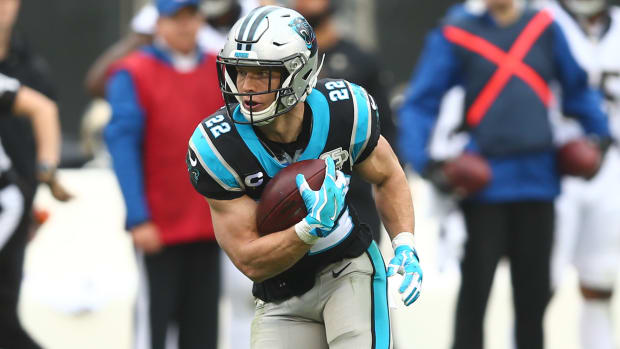
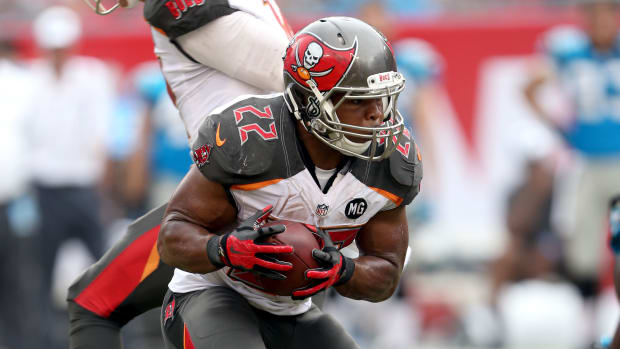
Fournette was the fourth overall pick of the Jaguars in 2017, while McCaffrey went four picks later to the Carolina Panthers. Both paid immediate dividends, as Fournette was the RB9 despite missing three games. His 18 points-per-game average was seventh at the position. CMC ranked 10th overall, producing 80 catches and 1,086 total yards.
After missing eight games in 2018, Fournette fashioned an RB7 finish in 2019 on the strength of a career-best 76 catches. His fantasy stock fell last season in Tampa Bay, but he did help the Buccaneers win their second Super Bowl championship. McCaffrey has gone on to true fantasy superstardom, ranking second and first in points in his next two seasons, respectively. He missed much of last season due to injuries, but CMC remains the consensus No. 1 overall pick heading into 2021 fantasy football drafts.
2016
Ezekiel Elliott
The fourth overall pick of the Cowboys in 2016, Elliott came right out and made a huge fantasy impact. His 325.4 points were good enough to finish second as a rookie, and it ranks fifth all-time among first-year runners. He missed six games the following season, but he was third among backs in points per game average. Zeke was the RB5 in 2018 and RB3 in 2019 before falling to RB9 this past season. Of course, he lost his starting quarterback, Dak Prescott, and the Dallas offensive line was an absolute disaster. In all, Elliott has established himself as a fantasy star and remains a first-round selection.
2015
Todd Gurley, Melvin Gordon
Gurley was the 10th overall pick of the St. Louis Rams, while Gordon went No. 15 to the San Diego Chargers. Gurley finished ninth in points as a rookie despite playing just 13 games, while Gordon failed to score a single touchdown and ranked as the RB48. Both backs went on to much greater things, of course, as Gurley was considered the top back in fantasy land in 2017-2018 before knee issues flared up and cost him both playing time and draft value. Even at just 26, his best days seem to be in the past. Gordon followed up his poor rookie campaign with finishes of RB7, RB5, and RB8. Now in Denver, he’s no longer considered “elite” but remains a No. 2 fantasy runner.
The first runner off the board in the 2014 NFL Draft was Bishop Sankey, who went in the second round (No. 54 overall) to the Titans. Jeremy Hill went next to the Bengals, and Carlos Hyde went to the 49ers two picks later. No one from this trio excelled in the NFL.
2013
None
No runners were picked in the first round of the 2013 draft, and the first back taken was Giovani Bernard in Round 2 (No. 37 overall). The second back taken was Le’Veon Bell (No. 48), who turned into a fantasy football superstar during his time with the Steelers.
2012
Trent Richardson, Doug Martin, David Wilson
Richardson was the biggest name among running backs in the 2012 class, and it looked like he’d be worth the third overall pick after finishing his rookie season as the RB7. It all went downhill from there though, as Richardson was traded from the Browns to the Colts. He never rushed for more than 519 yards in Indianapolis and was out of the NFL after 2014. Martin was actually better than Richardson as a rookie, finishing second in points behind Adrian Peterson. He missed 15 games over the next two seasons but came back with an RB4 finish in 2015. He was mostly inconsistent as a fantasy option, though. Wilson never rushed for more than 358 yards in a single season in the pros as a neck injury cut his career short.
2011
Mark Ingram
Ingram was the lone running back selected in the 2011 NFL Draft, and it took some time for him to make a significant fantasy impact. He was the RB47 as a rookie, RB40 as a sophomore, and RB63 while missing five games for the Saints in Year 3. He produced three 1,000-yard seasons in his next six years and emerged into a more reliable player in fantasy leagues up until this most recent season with the Ravens.
2010
C.J. Spiller, Ryan Mathews, Jahvid Best
Spiller (No. 9), Mathews (No. 12), and Best (No. 30) were the top backs in the 2010 NFL Draft, but none of them became true fantasy stars. Mathews was the best of the bunch as rookies with an RB7 finish, while Spiller was the RB27, and Best was worst at RB41. Spiller had a breakout 2011 campaign with an RB6 finish, but it was the only season he lived up to his actual NFL draft hype. As for Best, he missed 10 games in NFL Year 2 in Detroit and never again made an impact for the Lions or fantasy footballers.
Breakdown
Since 2010, a total of 17 running backs have been drafted in the first round. Ten of them (59 percent) finished in the top 10 in fantasy points as rookies. The next best finishers were Jacobs (RB21) and Edwards-Helaire (RB22), while the remaining five didn’t have much value during their respective rookie campaigns. Still, 12 of 17 first-rounders were at least low-end No. 2 fantasy running backs based on their final season totals.
Digging a little deeper and leaving out the 2020's first-rounder (Edwards-Helaire), who has only one NFL season under his belt, we’ve seen a total of five running backs reach elite status at some point in their careers. That list includes Gurley, Gordon, Elliott, McCaffrey, and Barkley. Fournette has put up high-end totals twice in four seasons, and Ingram finished his career on a high note with the Saints and Ravens (2016-2019). Jacobs had an RB8 finish as an NFL sophomore and seemed to be a surefire top-15 pick in 2021 drafts, but that all changed when the Raiders decided to bring in the veteran Drake as a free agent this offseason. Sorry, but we now “hate the Drake.”
In all, only Penny, Michel, Wilson, and Best have been complete duds among first-round running backs in the last 10 years. Richardson and Spiller didn’t meet expectations, but each of them did at least have one top-10 fantasy season.
So, will there be any first-round running backs in the 2021 NFL Draft? Clemson's Travis Etienne and Alabama's Najee Harris seem like the best bets if you look at the draft experts. Javonte Williams out of North Carolina has snuck into the backend of some first-round mocks too. Whoever does have their name called in Round 1, the trend of backs being selected highly and finding success seems to be a positive one for fantasy fans.
Michael Fabiano is an award-winning fantasy football analyst on Sports Illustrated and a member of the Fantasy Sports Writers Association (FSWA) Hall of Fame. You can follow Michael onTwitter,Facebook,YouTube, andInstagramfor all of the latest breaking fantasy football news and the best analysis in the business!
Take your game to the next level with an SI Fantasy+ subscription. Get insights from Michael Fabiano, Shawn Childs, and the entire fantasy team all year-round
NFL’s new media contracts are massive, with cumulative value north of $100 billion over 10 years. The incumbents—CBS, NBC, Fox and ESPN/ABC—almost doubled their current rights fees. And, for good measure, Amazon doubled what Fox is currently paying for Thursday Night Football. The deals suggest 1) broadcast television is not as dead as people think, at least broadcast television that carries the NFL, 2) it is always a waste of time to debate week-to-week or year-to-year ratings of NFL games, as media contracts always go up regardless, and 3) NFL franchise values will now skyrocket. NFL owners secured a team-friendly 10-year CBA with the players a year ago that had a 17th regular season game as part of it; they then went to the networks armed with labor peace and 17 games and came out $100 billion richer. Now with media contracts averaging $300 million annually, combined with a player cap that may not even exceed $200 million until 2024, the math is heavily tilted for management. There has never been a better time to be an NFL owner. Remember when concussions, or player protests, or domestic violence or various other issues were expected to be the one that would knock the NFL off of its perch? That was cute.
2.Contract reporting is still a mirage
The hyperbole of media reporting of NFL player contract value bothers me every year, probably more than it bothers others. It just seems disingenuous to see media constantly portray contracts in the best light possible for the agent and the player, with numbers that are not real. I get it: Relationships with agents are important. I know that well. But I do wonder about journalistic standards for reporting on contract values that, unlike guaranteed NBA and MLB contracts, don’t paint a true picture of the deal. As an example, at this time last year the Dolphins signed Kyle Van Noy to a reported “four-year, $51 million contract.” Van Noy was cut last month, having made $15 million, with no remaining obligation from the Dolphins. I know few care as much as I do, but player contract reporting around free agency is a mirage.
3.Quarterbacks: You get what you get
My previous column discussed the strength of Dak Prescott’s contract, due in large part to his being on the precipice of free agency. NFL teams never let ascending young quarterbacks hit the market; that would be franchise suicide. Thus, the group of free agent quarterbacks this year looks a lot like it does every year, with names like Ryan Fitzpatrick, Tyrod Taylor, Andy Dalton and diminished versions of James Winston and Cam Newton. When Bears fans lament the Dalton signing, my question is: Who exactly did they think was going to be their quarterback? Putting hopes into trading for Russell Wilson or Deshaun Watson (both of whom I maintain will not be traded) is like buying a Powerball ticket. The best time to find a quarterback is when you don't need one (see the Packers). Speaking of which …
4.Trading at the top
Friday saw the 49ers move up from 12th in the draft to third, giving up 2022 and 2023 first-round picks to the Dolphins. Of course, no team would trade those assets for any position besides quarterback. The 49ers are saying incumbent quarterback Jimmy Garoppolo is staying, which brings to mind the George Constanza line: “It’s not a lie … if you believe it.” The 49ers prepared themselves well to move on from Garoppolo: By front-loading $37 million of cap space in the first year of that deal, trading him would leave a dead-money charge of less than $3 million, a far cry from the $34 and $22 million albatrosses of Carson Wentz and Jared Goff. And speaking of Wentz, the Eagles moved down from sixth to 12th, securing the Dolphins’ 2022 first-round pick in the process. They now potentially have three first-round picks next year, ammunition if Watson or Wilson (or Aaron Rodgers) become available, or to package for a top quarterback next year. In other words, they have assets now to replace the quarterback (Jalen Hurts) who replaced the quarterback (Wentz) costing them $34 million against the cap this year.
5.Voidable for the desperate
Many continue to ask me about voidable contracts, such as ones signed by Taysom Hill and JuJu Smith-Schuster, among others. To put it simply: The Saints and Steelers were so desperate for cap space that they added fictitious years to those deals to spread out the cap hit. Hill and Smith-Schuster will still make the $12 million and $7 million, respectively, that they were supposed to make in 2021, but most of it will be bonus (prorated) instead of salary (not prorated) in order to push out cap room. And the fake years? They will automatically void after this season. This is what teams in desperate cap situations have to do to survive short-term. Speaking of which ...
6.Spiked cap: a false promise
The rationalizations regarding voidable years and restructuring are out there: It’s O.K. because there will be cap spikes in future years with the massive TV deals. Well, no. Anticipating cap spikes is a hope, and a hope is not a plan. It may be three years before the cap even reaches the level where it was supposed to be this year. Teams like the Saints and Steelers have been pushing the can down the road for years and look where they are now: declining teams with no Drew Brees and an aging Ben Roethlisberger. The Rams have thrown caution—plus dead cap and first-round draft picks—to the wind for a few years in their “win now” philosophy. Of course, only one team each year truly “wins now.” Here is the reality: There are 10 to 12 teams that have not had to resort to Cap restructures or voidable years. The other teams have essentially given those 10 to 12 teams a $10-20 million head start on next year or the year after. Teams that manage the cap well are always going to have an advantage over poorly-managed teams, regardless of what number the cap is.
7.Patriots’ tight end obsession
I said it for weeks: The diminished salary cap presented an opportunity for well-managed teams to separate themselves. The Patriots—among others, including the Jaguars—targeted 2021 as a year to spend liberally to gain a competitive advantage in a depressed market. However, in looking at their first-day deals, it appears they did not think the market would be as depressed as it was. They signed the top two tight ends on the market, Jonnu Smith and Hunter Henry, to contracts valued at $12.5 million per year. The Patriots never pay wide receivers, running backs or (since Tom Brady) quarterbacks, but they do pay tight ends, going back to when Rob Gronkowski and Aaron Hernandez were the highest paid duo in the league. While many NFL teams allocate scraps to the tight end position, the Patriots will be paying two of them a combined $35 million this year.
8.Deshaun’s Watson’s legal troubles
The talking points around Deshaun Watson have taken an extraordinary turn. There are no more hot takes about trades and Photoshopped jerseys, not with 19 (and counting) civil lawsuits against Watson alleging sexual misconduct, and new allegations in a Sports Illustrated exclusive Monday afternoon. The lawsuits will take much time to sort out as the two bombastic Texas lawyers spin their advocacy. Of more interest to me is an NFL commissioner who has repeatedly and consistently levied discipline against players—including high-profile ones such as Ben Roethlisberger, Ezekiel Elliott and James Winston—for conduct that did not result in criminal charges. Even with what little we know, it is hard to see Watson escaping the long arm of Goodell here, given the precedent. And, of course, no team is now considering trading for Watson anytime soon.
9.More, not less, Dan Snyder
As a native Washingtonian who grew up a diehard fan of the team, I am acutely aware of the fan base’s negative emotions toward majority owner Daniel Snyder. And that was even before reports of a hostile work environment toward women and cheerleaders being groped on junkets for season ticket holders. Now Snyder has bought out his unhappy minority partners who wanted out due to—you guessed it—Snyder. The result: The franchise is more inextricably linked to Snyder than ever before. To be fair, Snyder has made some stabilizing hires of the top of the football and business sides in Ron Rivera and Jason Wright, and that bodes well for the future. But to those wanting less Snyder: Sorry, you are getting more of him.
10. Pride in Parker’s pride
Finally, I am now in the third chapter of my career: The first chapter was being an agent, the second was being a team executive and the third is trying to give back by teaching, writing, broadcasting, podcasting and lecturing on sports from my unique perspective. I felt some pride in giving a little back this week. I have been advising Brandon Parker, a young agent working for Vayner Sports, who is the son of one of my mentors, the late great agent Eugene Parker. When Eugene—who was as knowledgeable about player value as any agent I had met—tragically passed away a few years ago, I made a vow to give back to his sons if I could. And last week Brandon negotiated a three-year, $63 million deal with the Giants for Leonard Williams. The deal has a top-of-market average, a practical full guarantee and only a three-year term for a player at a premium position, ensuring Leonard another bite of the free agency apple again at age 29. Brandon made both me—and his late, great father looking down from above—quite proud.