all the glitz and glamour, but Rounds 2 and 3 are the real meat of the NFL Draft, where teams’ preferences diverge, steals are to be had and pick announcements begin to be met with quizzical-but-polite applause from even the most fervent fans. Aside from the fact that we don’t know if Aaron Rodgers or Jordan Love got a new receiver on Friday, here are our picks for the night’s winners and losers.
Winners
Dave Gettleman
What if I told you … Dave Gettleman traded down not once but twice in the first two rounds of the NFL Draft? And that he still was able to get a difference-making receiver in Round 1 and an edge rusher with first-round ability in Round 2? It’s a heck of a haul. Azeez Ojulari was an extremely productive rusher at Georgia—15 sacks in 23 games—and medical red flags may have contributed to his dropping out of Round 1. But Ojulari told reporters that there are no problems with the knee he tore in high school; he was also cleared by James Andrews. If that is the case, the Giants will have gotten a major steal at No. 50—while also picking up a 2022 third-rounder. Savvy, tendency-breaking performance for the Giants GM.
Yes, the Chicago Bears
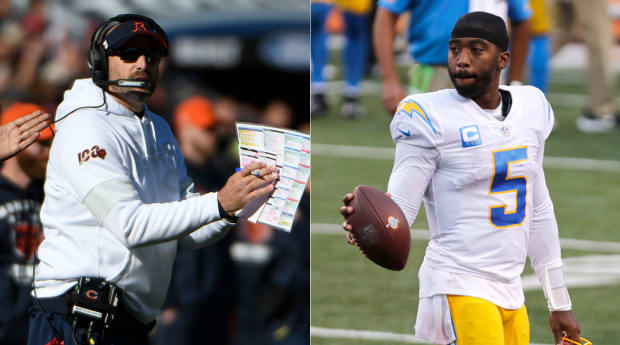
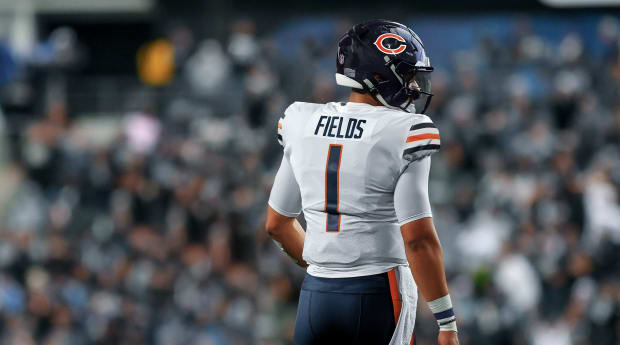
The Bears did the opposite of the Giants, trading up in both Rounds 1 and 2, but both were sensible moves to land players that could change the team’s fortunes. After moving up for Justin Fields on Thursday night, Chicago traded up again to nab a big protector for their new QB: OT Teven Jenkins, who did not allow a sack in his last two seasons at Oklahoma State. Jenkins, who many expected to be taken in the first round, projects as a starting right tackle. GM Ryan Pace and head coach Matt Nagy had to go for it in this year’s draft, and they did so shrewdly.
L.A. Chargers’ Draft Board
Not only was OT Rashawn Slater still available when the Chargers picked at No. 13, but on Friday night, CB Asante Samuel, Jr. fell to them at pick No. 47. Tackle and cornerback were the Chargers’ two biggest needs, and with each pick they got a player widely expected to be gone at that slot.
Sam Darnold
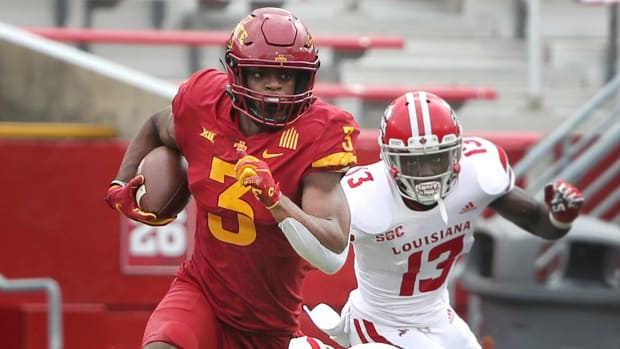
While his old team is giving its new quarterback the support Darnold never had, his new team is doing a lot for him, too. The Panthers used all of their Day 2 picks to support their QB, selecting WR Terrace Marshall, Jr., OT Brady Christensen and TE Tommy Tremble.
Dan Quinn
The Cowboys’ first four picks were, necessarily, all on defense, a boon for a new defensive coordinator. After taking LB Micah Parsons in the first round, Dallas added Kentucky CB Kelvin Joseph in Round 2, and UCLA DT Osa Odighizuwa and Iowa DE Chauncey Golston in Round 3.
Punctuality
For those of us (all of us) impatiently watching Kings of Leon perform a song from 13 years ago after the draft’s scheduled start time of 8 p.m. on Thursday, the lack of dawdling on Friday night was very pleasing.
GM Les Snead isn’t there because of a positive COVID-19 test (get well soon), there’s a creepy portrait of Roger Goodell looming over Sean McVay and the first name they turned in, 149-pound WR Tutu Atwell, received a, shall we say, lukewarm reaction.
Tyrod Taylor
H/T to editor Mitch Goldich who pointed out that Tyrod Taylor, yet again, is with a team that used a high draft pick on a QB. It was not as high as No. 1 (Baker Mayfield) or No. 6 (Justin Herbert), but pick No. 67 was the highest draft pick the Texans had, which they used to take Stanford’s Davis Mills (read more on what this means from Conor Orr).
The Analytics Crowd
Specifically, those who can no longer poke fun at Gettleman. He traded down! Twice!
Old Millennials
For those of us clinging desperately to the fleeting sense of feeling young, the realization that the NFL now has players born in the 2000s, like Marshall (June 9, 2000) and Ojulari (June 16, 2000), was a tough blow.
Roger Goodell’s chair
The commissioner’s brown leather chair, from which he conducted last year’s pandemic draft in his basement, made a commemorative journey to Cleveland. But unlike the artifacts preserved behind glass panels in the nearby Halls of Fame, this chair was handled by dozens of fans, poised to absorb stray glitter from team logo necklaces or alcohol-laced body fluids (how else were fans expected to stay warm?). Orr is confident this is not actually Goodell’s real chair—on the off chance it is, it will not be for long.
Anyone Standing Outside in Cleveland
Weather in Cleveland in late April is a gamble. It could have been worse, but ideally Adam Schefter would not have had to cocoon in a blanket.
not to mention formal legal proceedings—to wade through before we could even begin to talk responsibly about the idea of Deshaun Watson seeing an NFL field again.
His story has taken on an eerie quiet of late, as the football world has thankfully taken a break from reporting on the relentless wave of trade rumors that preceded the lawsuits of 22 women alleging sexual misconduct during massages over the last two years. Even the most hardheaded among us understand the idea that this must run its course before we return Watson’s primary context to a children’s game.
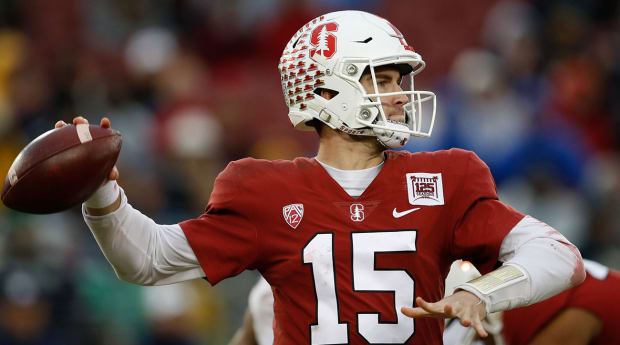
But with their first draft pick of the Nick Caserio era, the Texans seemed to signal what they thought the landscape might look like whenever we reach that point. By picking Davis Mills, a high-upside quarterback out of Stanford who was once the most sought-after recruit in the country, Houston admitted what we all thought a few months ago for very different reasons: Watson has played his last down of football in Houston, and perhaps in the NFL, for some time.
The first half of that statement was true back when he demanded a trade, even when Caserio and the new staff didn’t want to admit it. Back then, the phone was unplugged from the wall and the team treated Watson’s desires like the flailing of an emotional teenager. One day, it would pass and we would all move on, their public messaging seemed to say. It is all clearly true now, given that the NFL has acknowledged opening an investigation, and that a team so threadbare at every position on the roster decided to use its most significant morsel of draft capital on a quarterback.
A spin through Houston’s team needs heading into the draft was dizzying. Entire position groups will likely fail to reach the cumulative replacement-level threshold necessary for mediocre football. Outside of running back, where a platoon of late-career veterans swung by for a cash grab, the Texans will have a mountainous journey ahead of them to present a passable product in 2021.
Mills, like Tyrod Taylor, did not sign up for this. The situation will be chaotic and ugly. For the better part of a year, they’ll be operating under the cloud of circumstances beyond their control, as the organization struggles to lift itself out of both a disastrous personnel hole of its own making, and a crisis at the position that has mushroom clouded into something beyond its control.
As NFL Network noted during the broadcast, Mills did not have significant contact with the Texans throughout the process. He found out about their “interest” in him the moment most of the sentient football world did: late on Friday night when it was announced on TV. This isn’t subterfuge. This is grabbing a hold of the last sturdy object in the ground as the wind starts to pick up.
For the moment, this will be couched as pragmatism. Sure, if Watson’s situation suddenly clears and his grievances with the Texans magically subside, Mills remains a good player with high upside who can formidably back up a Pro Bowler and ably run Pep Hamilton’s offense. Pay no attention to what’s happening behind the curtain, because this is a move the Texans would have made regardless of the situation!
Of course, we all know that’s not the case. The team that has not come out and admitted, well, anything about their process (or lack thereof) to mollify Watson has said all it needed to say with the first chance it got to turn in a draft card. When the time is finally right to discuss the next phase of Watson’s football life, the hope in Houston is that the Texans will be in a place that doesn’t seem so chaotic, uncertain and wholly desperate as it does right now.
And maybe they’ll even have a blossoming young quarterback plucked out of the draft’s second-tier.
The Texans used its first pick of the 2021 NFL draft on Stanford quarterback Davis Mills in the third round. Houston's first and second round selections were dealt as part of the Laremy Tunsil trade back in 2019.
With Deshaun Watson's status uncertain, it's not surprising the Texans are adding to the QB room. Watson is facing 22 civil lawsuits with allegations of sexual assault and misconduct.
Mills was the eighth quarterback selected in the first 67 draft picks in this year's draft, and the third passer selected on Day 2.
The Norcross, Ga., native threw for 3,468 yards, 18 touchdowns and eight interceptions while averaging 7.9 yards per pass attempt in 11 starts in his college career.
Mills redshirted for the Cardinal in 2017 before backing up K.J. Costello in 2018. In his redshirt sophomore season in 2019, he made six starts and threw for more than 1,900 yards and 11 touchdowns.
In his final season at Stanford, Mills threw for 1,508 yards and seven touchdowns while completing 66.2% percent of his passes. The junior threw for seven touchdowns and three interceptions on the year.
Mills is the highest-drafted Stanford quarterback since former Colts quarterback Andrew Luck was drafted No. 1 in the 2012 NFL draft.
The Texans finished the 2020 season 4-12 and third in the AFC South behind the Titans and the Colts.
Three months after hoisting the Lombardi Trophy, the defending champs might have just nabbed their quarterback of the future.
The Buccaneers selected Florida quarterback Kyle Trask with the final pick of the second round, acquiring a potential replacement for 43-year-old Tom Brady.
Trask put together a banner senior season at Florida, throwing for 4,283 yards with 43 touchdowns and eight interceptions, leading the country in scoring passes. He was a finalist for the Heisman Trophy, finishing fourth in the voting behind DeVonta Smith, Trevor Lawrence and Mac Jones.
Florida coach Dan Mullen wished Trask well on Twitter, calling Trask "the true definition of perseverance and grit."
After five quarterbacks were selected in the top 15, none were taken until Trask's selection at pick No. 64. Trask will compete with Blaine Gabbert and Ryan Griffin for the backup quarterback job behind Brady.
Brady will turn 44 in August and is set to begin his 22nd season in the NFL. Last year, he completed 65.7% of his passes for 4,633 yards, 40 touchdowns and 12 interceptions. He threw 10 touchdown passes in the playoffs, including three in the Super Bowl to win Super Bowl MVP honors for the fifth time in his career.
Broncos fans, meet your new running back—Javonte Williams.
In an early second-round trade, Denver sent its No. 40 and 114 picks to the Falcons in exchange for their No. 35 and 219 picks. In doing so, the Broncos leap-frogged Miami to snag the North Carolina star, who the Dolphins were rumored to have their eyes set on.
Williams had a breakout season in 2020 as he and teammate Michael Carter formed the top running back duo in the country. They set an NCAA record against the Hurricanes, rushing for a total of 544 rushing yards between them (236 for Williams, 308 for Carter).
Williams finished the season ranked third in the FBS with 19 rushing touchdowns and sixth with 1,140 rushing yard. Williams ended the season ninth in the FBS by averaging 7.3 yards on his 157 carries.
He's the third running back off of the board, following Najee Harris and Travis Etienne from the first round on Thursday.
Williams fills a gap for the Broncos left by Phillip Lindsay, who signed with Houston during free agency. The franchise does still have Melvin Gordon, who rushed for 986 yards and nine touchdowns last season.
Wide receivers Jaylen Waddle and DeVonta Smith each went in the top 10 to the Dolphins and Eagles, respectively, joining former Alabama quarterbacks Tua Tagovailoa and Jalen Hurts. Cornerback Patrick Surtain II also went in the top 10, getting picked by Denver at No. 9.
After speculation that he could go as high as No. 3, quarterback Mac Jones slipped to No. 15, where the Patriots drafted him to compete with incumbent starter Cam Newton. The Raiders took offensive lineman Alex Leatherwood two picks later at No. 17.
The Steelers made Najee Harris the first running back drafted when they selected him with the No. 24 pick.
The strong draft showing this year continues the run of success from Alabama's 2017 recruiting class. That group has produced eight first-rounders over the past two drafts, with Smith, Jones, Leatherwood and Harris getting picked this year. Last year's draft featured 2017 signees Tagovailoa, offensive tackle Jedrick Wills, wide receiver Henry Ruggs III and wide receiver Jerry Jeudy, all of whom were taken in the top 15.
Ryan Pace and Matt Nagy could not go into 2021 with Andy Dalton as their presumptive starter. It was not in the best interest of the Bears. It was not in their own personal best interests, with pressure mounting each time Patrick Mahomes torpedoed another behind-the-back touchdown pass, reminding the Bears of what could have been.
Now, thanks to some masterful board work and a timely spring up eight spots, they have instantly transformed themselves from a middling franchise aggressively burrowing toward the mean, while squandering sound play-calling acumen in the process, to something worth game-planning for.
A quarterback obviously changes everything; this was the same thing Pace thought a few years ago when he took Mitch Trubisky. It was the same thing he thought when he stumbled over himself to acquire Nick Foles. But the outlook of the franchise changes considerably now with the arrival of a dual-threat passer who could end up being the second-best quarterback in the class.
During his junior season at Ohio State, Fields added nearly half a point per dropback in terms of EPA (0.32), which was higher than Trevor Lawrence at any point in his Clemson career. Nearly 90% of his balls during his senior year were scored “catchable” from the scouting service Sports Info Solutions. Throughout his college career, his quarterback rating while under pressure was above 100. He torched man and zone coverage with equal efficiency.
This is something that Nagy, a gifted play-caller who has been desperately trying to find ways to stretch out his offense and incorporate many of the wrinkles he smuggled with him from Kansas City, has never had before. In the past, Bears games were a showcase in covering up the fact that anyone was under center at all. All of the gadget plays Nagy became known for during their run to the playoffs in his first season there were not a window into his philosophy, but a visual interpretation of his strain to move the ball forward.
Sometimes, it’s just easier to flip the ball behind your back to Tarik Cohen and then have him pass it to a tackle than to call what you’d like your quarterback to run in the red zone.
Sticking with Pace through it all was a move that caused a lot of agony in Chicago, especially as he actively flailed to make it work, masking the deficiencies with one extraneous signing after another. But in many ways, one has to wonder if Pace was uniquely qualified to take this second swing. Fields could not be more different from Trubisky, and not just in terms of playing style.
In Fields there is more evidence. There is less blind faith. There is more you know you can do on Day One. More that a defense has to account for. We’ll now see the best of Nagy, who was still able to drag this team into the playoffs twice despite the most important position on the field weighing him down.
Those who obsess over the Bears never expected Pace to be the one to save them after everything he’s been through. But only Pace knew how badly he had scrambled the process the first time, and what it would take to piece his vision back together if he had a second chance.
A few hours before the start of the 2021 NFL draft, former Alabama star Najee Harris visited a homeless shelter, Greater Richmond Interfaith Program (GRIP), as they hosted a draft watch party in his honor.
It was a homecoming of sorts for the Steelers' No. 24 pick, as Harris, his four siblings and his parents lived in that shelter for several years growing up.
"Just to see him as a grown man with this kind of opportunity for him today and to know that he lived in this shelter among many other places their family had to move around and lives as a homeless man just speaks to [the thought that] anything is possible," Kathleen Sullivan, executive director of the Greater Richmond Interfaith Program, told ABC 7 News.
Harris wasn't just there to say hello, though. He also brought food for the current residents. He told reporters, "There was a time I needed a helping hand. They gave us an opportunity to get back on our feet. So it is my job to give back."
Returning brought back a lot of stirring memories for Harris and his family. He was in middle school when they stayed at GRIP before his family moved to Antioch.
"It was really emotional for my mom," Harris said. "Almost as if she was crying, in a way, because we have a lot of memories here. That was a time in my life when it was really low."
Harris went on to be one of Alabama's most explosive players, rushing for 1,224 yards and averaging 5.9 yards a carry as a junior in 2019. Despite looking NFL ready, he returned to the Crimson Tide as they battled for another national championship. He went on to win the Doak Walker Award as the country’s top back last season, rushing for 1,466 yards.
The Jets made a move to protect new quarterback Zach Wilson as they traded up to the No. 14 pick in the 2021 NFL draft on Thursday.
New York selected USC offensive lineman Alijah Vera-Tucker with the No. 14 pick. It sent Minnesota pick Nos. 23, 66, 86 in the deal in order to receive Vera-Tucker and pick No. 143.
Vera-Tucker played two seasons at USC, earning All-Pac-12 honors in 2020. He is New York's second first-round pick on Thursday after the Jets drafted Wilson at No. 2.
New York has missed the postseason in each of the last 10 seasons. It finished last in the AFC East in 2020 at 2–14.
In the span of three months, Mac Jones has gone from winning the national championship during a global pandemic to being selected by the Patriots as the No. 15 pick in the 2021 NFL draft.
The 22-year-old, a redshirt junior who was a 2020 Heisman Trophy finalist, still had two seasons of eligibility left given the additional year that the NCAA added across all college athletics due to the COVID-19 pandemic. He finished third in the Heisman Trophy voting, threw for 4,500 yards and 41 touchdowns with four interceptions and a 77.4 completion percentage.
During the national championship in January, Jones tallied 464 passing yards and five touchdowns, shredding the Buckeyes' defense in a 52-24 victory.
Although the Patriots spent a substantial amount during free agency, they were quick to pick Jones at their first chance. The franchise finished 7-9 last season with quarterback Cam Newton at the helm after losing Tom Brady to Tampa Bay.
"As much as the 49ers love Mac Jones, and they do, I believe that the gap between Mac Jones and the other QBs like Trey Lance has been narrowed considerably," Schefter said Wednesday. "I can tell you over the weekend they did not know who they were going to take."
Coming into this year's draft, the expectation was the Bears would take a quarterback at some point, if not in the first round then sometime over the weekend. Instead, Chicago couldn't wait that long.
The Bears traded up from pick No. 20 to No. 11, then selected Ohio State quarterback Justin Fields as the franchise's next quarterback.
In the deal, Chicago received the 11th pick in this year's draft, and sent the No. 20 pick to the Giants, along with a 2022 first-round pick, a 2022 fourth-round pick and a fifth-round pick for 2021.
The 22-year-old heads to the NFL after beginning his college career at Georgia in 2018 before transferring to Ohio State in 2019. Fields starred in his two years with the Buckeyes, throwing for 63 touchdowns and nine interceptions over 22 games while completing 64.8% of his pass attempts.
The quarterback led Ohio State to the College Football Playoff each season, with the Buckeyes falling to Alabama in last season's national title game.
The Bears last took a quarterback in the first round in 2017, when they traded up to tack Mitchell Trubisky with the No. 2 pick. Chicago infamously chose Trubisky over Patrick Mahomes and Deshaun Watson.
Trubisky struggled to kick-start the Bears' offense and signed a one-year deal with the Bills this offseason to back up Josh Allen. The Bears signed veteran quarterback Andy Dalton this offseason on a one-year contract.
Fields's draft stock was all over the board, his projection remaining in the top three until the final days leading up to the 2021 NFL draft. He had been a longtime favorite of the 49ers before reports surfaced that the franchise was more interested in Alabama's Mac Jones and North Dakota State's Trey Lance.
Last week, Fields reportedly informed teams that he is managing epilepsy. He was diagnosed with the neurological disorder as a child and has seen his symptoms get shorter and more infrequent over time, according to NFL Network's Ian Rapoport and Tom Pelisserro.
NFL Network reported that the disorder, which does cause seizures, has not impacted Fields's football career, and doctors expect him to outgrow it. He does take medication for the diagnosis.
Fields is not the first NFL player to manage an epilepsy diagnosis, including Hall of Fame guard Alan Faneca, who took medication to control seizures throughout his career.
Last year's Heisman Trophy winner has found a new home. The Eagles have selected Alabama wide receiver DeVonta Smith with the No. 10 pick in the 2021 NFL draft.
Smith was the third receiver taken in the first round, following Ja'Marr Chase and Jaylen Waddle. The dynamic playmaker put together a historic senior season in Tuscaloosa, leading the country in catches (117), receiving yards (1,856) and receiving touchdowns (23) to become the first wide receiver in 29 years to win the Heisman Trophy.
Smith saved his best for last, hauling in 12 catches for 215 yards and three touchdowns against Ohio State in the national championship game, which Alabama won, 52-24.
For his career, Smith totaled nearly 4,000 receiving yards and 48 total touchdowns. He burst onto the scene as a freshman in 2017 when he caught the game-winning touchdown pass in overtime of Alabama's national championship game win over Georgia.
The Eagles traded up to the No. 10 slot to acquire Smith on Thursday. They sent Dallas the No. 12 and No. 84 picks in the 2021 draft in order to move up two slots.
Despite his record-breaking season, questions about Smith's ability to play at the next level lingered during the pre-draft process, largely due to his small frame. Smith measured at 6'1" and 170 pounds, though Alabama coach Nick Saban was adamant that Smith's small stature will not prevent him from being successful in the NFL.
"Tell me how many receivers are tougher than he is—that block better, that play more physical than he does—so I think maybe there's a time when you say 'This guy really overcomes the fact that he's not the biggest guy in the world and he really plays this game really, really well,'" Saban said in March. "I don't think anybody can argue that fact."
Jaylen Waddle went from suffering a presumed season-ending ankle injury to winning the national championship last season.
He's now headed to the NFL after the Dolphins selected the wide receiver at No. 6 in the 2021 NFL draft.
Waddle started the 2020 college season with a bang at Alabama last fall, topping 120 receiving yards in four consecutive games to start the season. He tallied 557 yards on 25 catches, adding with four touchdowns during the stretch.
Waddle missed six games after suffering a high-ankle sprain against Tennessee. He returned to the field in before suiting up for the national title game. While visibly limping at times, the wideout hauled in three catches for 34 yards.
"My hat's off to him," head coach Nick Saban said when Waddled declared for the draft. "I had the same injury, so I know the difficulties coming back from that. You're healed but your ankle is so stiff, it's difficult to sort of get the flexibility and the flexion back so you can explode like you want to, especially when you drop your weight on that foot, which comes when you're slowing down, trying to make a cut.
"I have a lot of respect for Jaylen Waddle. His mental toughness and his ability to be able to come back."
During his three-year career with the Crimson Tide, Waddle tallied 106 receptions for 1,999 yards, averaging over 18 yards per catch. He totaled 17 touchdowns, plus three special teams scores.
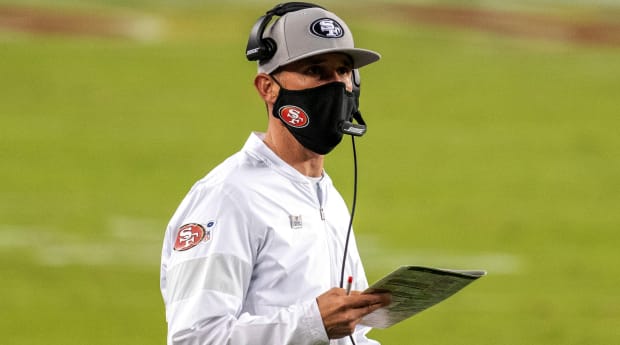
the Falcons’ record-setting blown 28–3 lead in Super Bowl LI raised questions about his feel for big moments. His performance as the 49ers’ head coach and offensive play-caller in Super Bowl LIV, another double-digit blown lead, was another thwack against the side of the wall. He is a man of contradictions. On one hand, he has developed the offense run by almost a quarter of the NFL. Coordinators from his tree, or those simply smart enough to buy the starter kit on EXOS and imitate it from scratch, are getting hired at a feverish pace. On the other hand, he is 29–35 as an NFL head coach, with just one winning season in four years.
A person of sound mind could argue that his one winning season, which ended in the 49ers’ loss to the Chiefs down in Miami, was due in large part to the 49ers’ defense (second in DVOA) and less the offense he oversaw (seventh in DVOA). Injuries, in addition to some notable big-game performance lapses at the quarterback position, almost certainly played a factor as well.
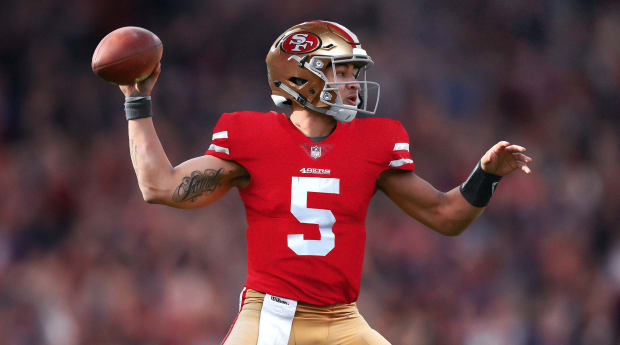
And yet, there is something undeniable about his acumen, which makes San Francisco’s selection of Trey Lance with the No. 3 pick on Thursday night all the more fascinating. For years we have often chastised players for not living up to their draft position, as if they chose the arbitrary number and extraneous pressure themselves. But this pick, for better or worse, will be more of a direct reflection on Shanahan himself.
Of the possible options (Lance, Mac Jones and Justin Fields among them), Lance is especially polarizing. He threw the fewest attempts out of any of the top quarterbacks available. He played just one game last season. One could view it as Shanahan’s ultimate vote of confidence in himself.
Above the missteps in Super Bowl LI and the unevenness of the last four years, this draft pick could be the defining moment of Shanahan’s early legacy—the buoy that keeps his boy genius reputation afloat, or the heavy metal ball that finally slips off the table’s edge.
Throughout the draft process, we have been subject to the performative ballet of a sage football mind. Admittedly, there was something brilliant about cloaking this decision for as long as the 49ers did. It kept us all guessing, sure. It probably annoyed some of their opponents and the rest of the league, all of whom were possibly looking to lock in trades behind the 49ers to grab whomever they did not. Among the better-leaked tidbits were quarterbacks other than Mac Jones working with Shanahan’s friend and former pupil John Beck, as if they were all being privately vetted for a White House cabinet position.
Now, though, Shanahan has made a concrete decision. The creator of the offense has decided on the avatar who will run his system. Soon, faults cannot be blamed on youth or inexperience or injury. Soon, there will need to be a return on all of the fawning equity that has been placed on the head coach, who strolled into his first job with a contract nearly twice as long as the average coaching life cycle itself.
Much of it is deserved. Shanahan’s talent is undeniable. The way in which he’s turned the draft into a ready-made factory of receiving threats who continue to diversify his offense. The way in which he seems to scoop up a handful of running backs out of the heap and turn them into monstrous downhill threats. With the right quarterback, this team is designed to be good for a very long time. It didn’t waste long identifying the fact that Jimmy Garoppolo was not the right quarterback.
But as coaches will tell you, the minute you make this kind of move—the minute you sacrifice capital and pour your heart and brain out for everyone to see—that’s the moment the clock really starts on what will always be thought of you, and whether the rest of the journey continues to resemble the bumpy ride through the pinball machine.
Although he opted out of the 2020 season, the LSU wide receiver had little to prove after winning the Biletnikoff Award as the nation's top receiver in 2019 and helping the Tigers win the national championship that season. Chase tallied nine receptions, 221 yards and two touchdowns in the victory over Clemson.
By the end of the season, he set SEC records and led the FBS with 1,780 receiving yards and 20 receiving touchdowns in 14 starts.
As a true freshman in 2018, Chase totaled 23 receptions, 313 yards and three touchdowns while starting seven of 13 games.
The move reunites Chase with his college quarterback, Joe Burrow. The pair helped lead LSU to an undefeated national championship season in 2019. Chase caught 84 passes for 1,780 yards and 20 touchdowns, averaging over 21 yards per catch and winning the Biletnikoff Award as the nation's best wide receiver.
Chase will team with Tee Higgins and Tyler Boyd to provide Burrow with a bevy of weapons on the perimeter. In 10 games, Burrow completed 65.3% of his passes for 2,688 yards, 13 touchdowns and five interceptions.
As rumors floated throughout the offseason that the Bengals had their eyes set on Chase, ESPN’s Jeremy Fowler reported on Wednesday that the Lions tried to trade up to No. 4 to land Chase.
“There was chatter early in the week that the Lions tried to trade up to No. 4 to get Chase, but the Falcons’ asking price was too high,” Fowler wrote.
The 20-year-old, who played for the University of Florida, was selected No. 4 overall and is now the highest tight end ever drafted. Pitts was named a first-team All-American and won the John Mackey Award as the most outstanding tight end in college football this past season.
He is the first tight end to go in the top five in 49 years (ex-Broncos Pro Bowler Riley Odoms went fifth in 1972). Only four tight ends (Vernon Davis in 2006, Eric Ebron in 2010, T.J. Hockenson in 2019 and Kellen Winslow in 2004) have gone in the top 10 over the last 24 drafts.
Pitts was also the first tight end to be named a Fred Biletnikoff award (top wide receiver) finalist after catching 43 passes for 770 yards and 12 receiving touchdowns—tied for third-most in the FBS—in eight starts.
He's a dual-threat as a pass-catching tight end, and with being 6'6" and 245 pounds, Pitts can be a difficult matchup for linebackers and often too big against cornerbacks.
Like several of the other draft prospects, Pitts is one of the first players to join the league who was born in 2000. Trey Lance was the first player to be drafted born at the beginning of the millennium.
The Falcons went 4-12 last season, and head coach Arthur Smith will likely use Pitts all over the field.
traded up to the No. 3 pick in March in a deal with the Dolphins. San Francisco was expected to select Alabama quarterback Mac Jones for much of the last month, but Lance entered the conversation in recent days.
The 49ers did not tell their coaches or scouts who they would pick before the selection was announced, per ESPN's Adam Schefter.
the last time we went through this exercise, the one where we pretended the Jets’ acquisition of a quarterback was different this time. How it was, finally, an exercise in competence. How they won’t ruin this one like they did the last hundred. So forgive anyone who follows this team if they meet tonight with either the feigned interest of someone who has been beaten down over time, or the complete opposite: the beautiful, optimistic amnesia that a follower of this organization tends to acquire.
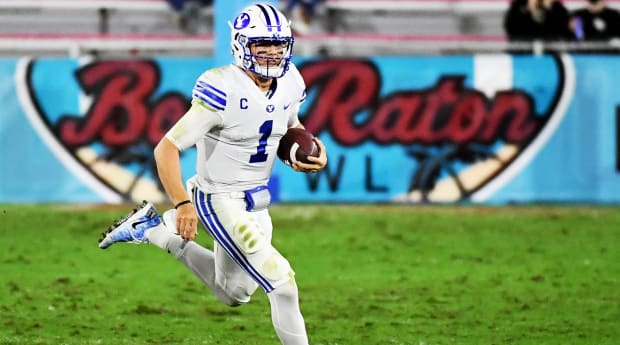
But here’s why Zach Wilson will actually, really, truly be different this time. He is joining an organization in arguably the healthiest place it’s been in for years. There is a general manager who hired a head coach. There is a competent offensive coordinator running the most quarterback-friendly system in the league. There are pillars in place to prevent the entire thing from collapsing, regardless of how long it might take for Wilson to develop.
Leave it to the Jets to wait until the age of nomadic quarterback movement to finally find the recipe for stability. Wilson and, by extension, any quarterback who the Jets take from here to eternity, may never get the chance to replace the Joe Namath-sized hole left in people’s hearts. But he can make them a passable franchise again. He can hoist them to something truly rarified: (somewhat) sustained relevance.
When Mark Sanchez was drafted, the team vacillated between irresponsible coddling and naked indifference. They loaded him up with mercurial wide receivers, completely ignorant of the chemistry Molotov cocktail they were creating and plastered him all over town as if he were the next Namath.
With Geno Smith, it was almost the opposite. From the moment he arrived, it was almost as if the organization was doing him a favor. Brief glimpses of talent and personality were quickly shuttered amid the administrative chaos plaguing the team. They offered more support to the sixth-round pick who uppercut him in the locker room.
With Sam Darnold, the offense was never prepared to support him. There were moments, quite literally, during his rookie year when the game plan featured various checks and calls that meant two different things. He made some brilliant throws in games despite the fact that some aspects of the game plan were irreparably broken. He got mono. He was tossed behind a paper-thin offensive line. He was beat up and had no one to throw to.
The promise of Joe Douglas and Robert Saleh and, by extension, Mike LaFleur, is that there is a general, harmonious competence with it all. Yes, LaFleur may not be his brother, Packers head coach Matt. He may not be Kyle Shanahan. But he has a deep understanding of the system, which gifts quarterbacks the kind of time and space to make correct decisions. It points them in that direction at the snap. This is the system that momentarily made the Mike Pettine Browns relevant. This is the system that rescued Ryan Tannehill’s career. That brought the Falcons to the Super Bowl. That was behind two straight 13–3 Packers seasons.
While the NFL is cyclical, there are few things that have been tested as rigorously.
There is a quiet desperation to this pick, though one that has little to do with Wilson proving the Jets right. Surely, if he does not succeed, there will be endless speculation as to whether the franchise should have dealt the No. 2 pick and used a bounty of selections in a far deeper 2022 draft to retool.
Instead, this is about the Jets finally proving their competence. Because, in the age where quarterbacks are no longer afraid to pack up and brawl their way out of town, who wants to play for a team that has no track record of development or success? Who willingly signs up for bad health?
Wilson being the first would mean more than just immediate success. It would mean an end to a twisted cycle years in the making.
The Jets selected Wilson as the No.2 pick during the first round of the 2021 NFL draft on Thursday evening. Wilson is the second quarterback off the board after Lawrence was drafted by the Jaguars with the No. 1 pick.
Wilson had a breakout year last season, ranking second in the FBS in completion percentage. He tossed 33 touchdowns and just three interceptions, and finished No. 10 in the FBS with a 307.7 passing yards per game. Wilson also rushed for 10 touchdowns in 12 starts for the 11–1 Cougars in 2020.
Wilson completed 62% of his passes in 2019. He threw for 2,382 yards and eleven touchdowns.
The Jets finished last in the AFC East in 2020 at 2–14. They traded Sam Darnold to the Panthers in early April, three years after drafting him with the No. 3 pick.
Wilson has a gunslinger mindset, possessing the arm talent to create explosive plays inside and out of the pocket. His strength was on full display during his Pro Day, where every NFL team was present except for the Rams. He threw multiple off-balance passes that went 50 yards.
"The goal today was to kind of show what makes me different, the type of throws I can make that I feel like other guys don't practice and don't try to do," Wilson said afterward on a Zoom call. "That was the goal—to show what makes me different."
Left out, at least for now, is a question that we should all be asking of Meyer in general as he embarks upon a moment that will forever alter his legacy for better or worse: Why on earth would he sign up for this?
The same might be asked of Lawrence who, just a few weeks ago, admitted that he hoped to have a life beyond football one day and was shredded by the game’s old guard for a perceived indifference. This league is a machine that swallows talent whole and spits it out for no good reason. And Lawrence has a bigger target on his back than any player who has crossed the threshold from college to the NFL since John Elway.
Behind it all is Meyer, who left the cozy life of a broadcaster to prove that he could do something almost no other coach has done successfully—take the secret sauce that made him a successful coach at a different level, with a completely different set of rules and parameters, and apply that trade to a league that is wary of any NCAA intrusion and takes a deep pleasure in fending off anyone giving it a try.
With Lawrence, everything is magnified. The pressure to build a staff is greater. The pressure to construct a complementary roster is greater. The pressure to turn this into a Super Bowl is much, much greater. Most of it rests on the shoulders of a man in his mid-50s, who has left various jobs for health reasons, succeeding at the highest level while also paying a deep personal cost.
In that way, coaches are a rare breed. The lot of us would be content to ride out the circuit, accept a life’s worth of free drinks in every college town in the country and gloat about the three national championship rings—the kinds of things people couldn’t take away from you if you were fully and completely retired.
Instead, he is signing up for something that is nearly impossible. He is trying to align his flawless (on field, not off) college pedigree with a quarterback pegged to rewrite record books since the moment he stepped on a high school football field as a lanky, marketable blonde and started lighting defenses up.
In that way, it’s truly a fairytale. In the NFL, you cannot simply outwork fellow coaches and succeed. You cannot simply outgrease them. Outscheme them. Outwit them. There has to be a complete and total immersion and understanding of the way things work, and a willingness to bend and twist it at every turn to your advantage. In order for Lawrence and Meyer to meet our outsized expectations, we will truly have to see something from the coaching profession we have never witnessed before: a complete metamorphosis late in someone’s life, leading to something that 31 other crazed, trophy-hunting coaches haven’t thought of yet.
Because that’s the expectation, right? Super Bowls. Pro Bowls. Big things. Fairytales. And that’s what we’ll get until the moment Meyer has to toe the sideline and prove that it’s all possible.
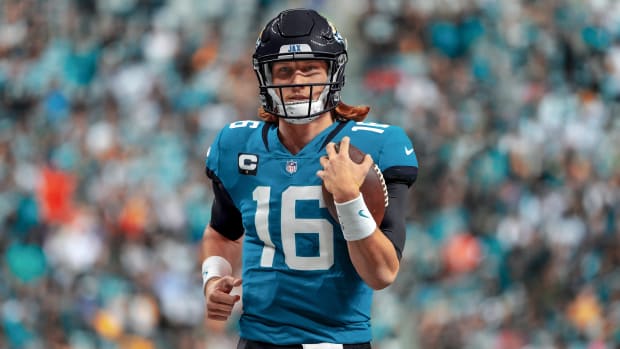
Jaguars selected Clemson quarterback Trevor Lawrence with the No. 1 pick in the 2021 NFL draft.
The Cartersville, Ga., native will travel nearly six hours to his NFL home in Jacksonville. He joins Jaguars first-year coach Urban Meyer, who never shied away from his interest in the quarterback from day one.
Lawrence entered the draft as the presumptive top pick, having excelled at Clemson, finishing his college career with the most wins by a quarterback in Clemson history (34), passing Rodney Williams, Tajh Boyd and Deshaun Watson.
He won the national championship in 2019 and played again in the title game the following year in Clemson's loss to LSU. In his final college season, Lawrence led the Tigers to a 10-2 record, and a third consecutive College Football Playoff appearance.
Overall, Lawrence's winning percentage (.944) was the third-best as a starting quarterback with at least 30 starts since the Division I split in 1978.
Jacksonville has not recorded a winning season since 2017 when the team finished 10-6 and lost to the Patriots in the 2018 AFC championship game. Jacksonville has compiled a 12-36 record since the 2017 season.
Move over Oscars, you may have just met your match.
The ongoing COVID-19 global pandemic didn't keep the 2021 NFL draft prospects from pulling out all of the stops as they sports show-stopping fits on the red carpet.
Former BYU quarterback Zach Wilson was seen wearing a Giorgio Armani suit while Florida's Kyle Pitts wore an all-green suit with cognac colored patches on his elbows. North Dakota State's Trey Lance was iced-out with a Cartier timepiece, and Alabama's Patrick Surtain II had a “PS2” chain made for him by Leo Frost.
Others were more sentimental in their approach.
Kwity Paye told GQ's Tyler R. Tynes earlier Thursday that Chadwick Boseman is his hero, and the ex-Michigan defensive end honored the first Black superhero in his suit. In fact, it was made by former Packers player Adonis Jennings.
Here's a round-up of the show-stopping looks from some of college football's finest players. Who had the best fit?
"I'm pleased to announce that Las Vegas will host the 2022 NFL draft, where we look forward to holding an even bigger and better event than we could have ever imagined this year," Goodell said at the time in a statement. "Congratulations to Las Vegas, the Las Vegas Convention and Visitors Authority, the Raiders' organization and Raider Nation."
When the draft was first announced to be heading to Sin City, the plan was set the draft stage at the famous fountains at the Bellagio Hotel. It's unclear whether that plan is still in place, though it certainly would be a well-received development a second time around.